How to Access GPT-4 and Claude API from China Without an Overseas Credit Card
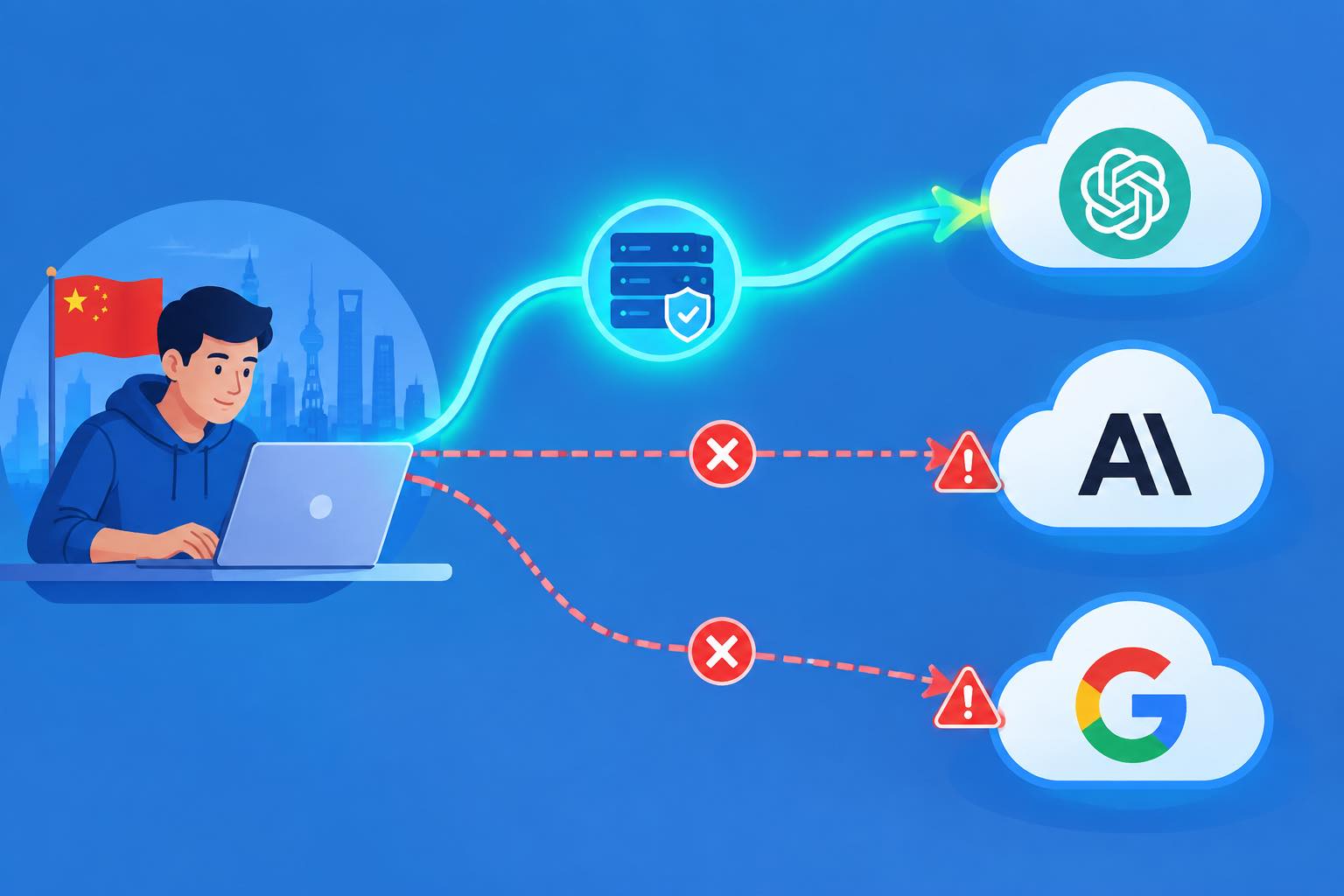
If you have ever tried to call api.openai.com from a VPS inside mainland China, you know the feeling: DNS resolves, TCP connects for a second, then the connection drops. If you somehow get through, the billing page asks for a credit card that starts with a US or EU bank, and a Chinese UnionPay card is just politely rejected. Claude is even stricter — Anthropic blocks most Chinese IPs outright, and OpenRouter, while better about cards, still expects you to be on a network it considers safe.
What actually blocks you
There are really two separate problems, and people keep mixing them up.
The first is network reachability. OpenAI and Anthropic do not serve traffic from Chinese IP ranges. Even if you have a VPN, the quality of that tunnel decides whether your retries look like a bot. A flaky tunnel that drops every few minutes will get you rate-limited faster than you can debug your prompt.
The second is billing identity. Both providers want a card issued outside mainland China and Hong Kong, plus a matching phone number. Virtual cards from Hong Kong banks work sometimes, but they also get flagged whenever the billing address, IP and payment fingerprint disagree. You end up burning a card per account.
OpenRouter sidesteps the billing problem (it accepts more payment methods) but not the network problem — from a Chinese IP you still need a stable outbound path, and a lot of OpenRouter models route through regions that Chinese networks dislike.
The workaround most Chinese devs actually use
The pattern that has been stable for the last year is a domestic relay endpoint. Instead of pointing your code at api.openai.com, you point it at a compatible endpoint that lives on a Chinese provider's infrastructure, speaks the same OpenAI or Anthropic protocol, and forwards the request upstream from a machine that is allowed to talk to the real vendor.
That sounds sketchy, and some of the cheap relays are exactly that. But the good ones are just proxies: your API key never leaves your control, the relay only sees traffic, and it supports the same model list you would use directly. The upside is boringly practical: signup with a mainland phone number, top up with Alipay or WeChat Pay, no foreign card required, and latency from a Chinese office feels like 200 to 600 ms instead of timing out.
Direct vendor vs OpenRouter vs domestic relay
Direct OpenAI or Anthropic is the cleanest option if you already have an overseas entity, a US card and a stable network. Otherwise it is mostly a research project.
OpenRouter makes sense if you want to mix many models under one key and you can already reach it. It is also honest about what it does. But it does not solve the Chinese network problem, and its free-tier models have gotten noisy lately.
A domestic relay wins on three things that matter day to day: signup friction (under two minutes), payment (your wallet already has the balance), and uptime from inside the country. You give up some direct-vendor features like advanced audit logs, and you should still read the relay's privacy page before sending sensitive prompts.
A few practical tips
Pick a relay that exposes the same base URL shape as the official SDK. That way you only change one constant in your code, and your existing retries and streaming code keep working.
Set a sane timeout. OpenAI's default long timeout is fine on a fast international link, but on a Chinese endpoint you want 60 seconds total and one retry, not ten. You will save yourself from cascading failures when the upstream vendor itself is slow.
Keep an eye on model names. Some relays map gpt-4o to a slightly different backend than the official one. Run a tiny smoke test on day one with the exact prompt you care about, not a generic "hello", and compare the output style before you ship.
Bottom line
If you are a developer in China and you just want to call GPT-4o or Claude without fighting with a foreign credit card, a domestic relay endpoint is the path of least resistance. It is not as pure as going direct, but it is the option that actually stays up at 2am on a Sunday. Direct vendors and OpenRouter still have their place — they are just tools for people who have already solved the network and billing side.